






 Tools for Jira
 Tools for monday.com





Marketing decisions based solely on assumptions rarely lead to good results. Whether you’re planning a new campaign, evaluating a channel, or trying to understand your competitors, structured research helps you move forward with confidence.
In this article, you’ll find ready-to-use marketing research templates, a guide on how to incorporate them into your Jira workflow, and practical tips from our marketing team.
What Does Marketing Research Typically Include?
Marketing research encompasses a wide range of activities. Essentially, it refers to any structured effort to gather information that helps a marketing team make better decisions.
While marketing research is a very broad term, there are several common types that every marketer should be familiar with
| Research Type | What It Covers |
|---|---|
| Target audience research | Understanding who your customers are, how they behave, what they need, and how they make decisions. This includes persona development, segmentation, and buyer journey mapping. |
| Competitive analysis | Studying what competitors are doing in terms of positioning, messaging, content, pricing, and channels. The goal is to identify gaps and opportunities, which can be done with SWOT analysis and other approaches. |
| Channel and media research | Evaluating which marketing channels are most effective for reaching your audience and where to invest next. This covers both organic and paid channels. |
| Content research | Analyzing which topics, formats, and angles resonate with your audience. This encompasses keyword research, content gap analysis, and trend monitoring. |
| Trend and industry research | Tracking macro trends, emerging technologies, and shifts in buyer behavior. These factors can significantly impact your marketing strategy. |
Any of these can be a standalone project or a section within a larger research initiative. Research teams often use visual tracking methods, with webpage capture API helping document changes in competitor and user-facing pages over time for analysis. The scope depends on your business context and goals.
When Do You Need to Conduct Marketing Research? Key Use Cases
There are several common situations when marketing research is essential. Here are the main ones:
- Building a marketing strategy for a new product or client. When you’re starting from scratch, research helps you understand the audience, the competitive landscape, and which channels and messages are most likely to work.
- Entering a new market or region. Audience behavior, competition, and effective channels can differ significantly from what you’re used to. Research helps you adapt rather than guess.
- Repositioning the brand or refreshing messaging. If your market has shifted or your product has evolved, research helps you validate new positioning before rolling it out.
- Conducting regular competitor analysis. Unlike many other types of marketing research, competitor analysis isn’t a one-time task. Competitors change their strategies, pricing, and messaging over time, so it’s important to revisit your findings periodically.
- Validating one more crazy idea: Investing time into researching the idea is a rule of thumb; a few hours of research can save months of guesswork.
What is a Marketing Research Template and How Can It Help You?
 Definition
A marketing research template is a structured framework that guides your team through gathering, analyzing, and documenting marketing intelligence. It can cover areas such as audience analysis, competitor benchmarking, and market research for a new country or region.
Depending on your workflow, a marketing research template can take various forms. In this guide, we focus on templates designed for agile teams using Jira or Monday. There are two main types to consider:
- A checklist template: a reusable list of steps that your team needs to follow during the research process. It’s placed inside a single Jira work item and helps keep things consistent and visible. To create a marketing research template in checklist format, use Smart Checklist for Jira by TitanApps.
- A work item template: a ready-made Jira task or a set of tasks with child work items. It can include standard descriptions, checklists, assignees, due dates, and variables. This format is a good fit for more complex research processes that involve multiple people or teams. Natively, Jira doesn’t offer work item templates, but you can create them with Smart Templates for Jira.
In this article, we provide templates of both types. They are optimized for Jira but can also be used with Monday.
Why Use a Marketing Research Template and Competitor Analysis Template
It may seem like a small addition to your workflow, but a good template solves several problems at once. By using such a template, your team can:
- Create a repeatable process that saves time on future projects
- Ensure that no critical steps are overlooked
- Make research progress visible to the team and stakeholders
- Keep the process consistent regardless of who runs the research
- Collaborate more easily when multiple people are involved
- Build documentation for future reference and stakeholder alignment
A Free Marketing Research Template in the Checklist Format
As I mentioned earlier, marketing research is a broad term encompassing many research types. In this article, we focus on two key types: target audience research and competitor analysis, for which we prepared reusable templates.
They were both created with Smart Checklist for Jira and can be added directly to your Jira work items. Feel free to adjust them by adding, removing, or rearranging steps to match your team’s workflow.
Target Audience Research Checklist
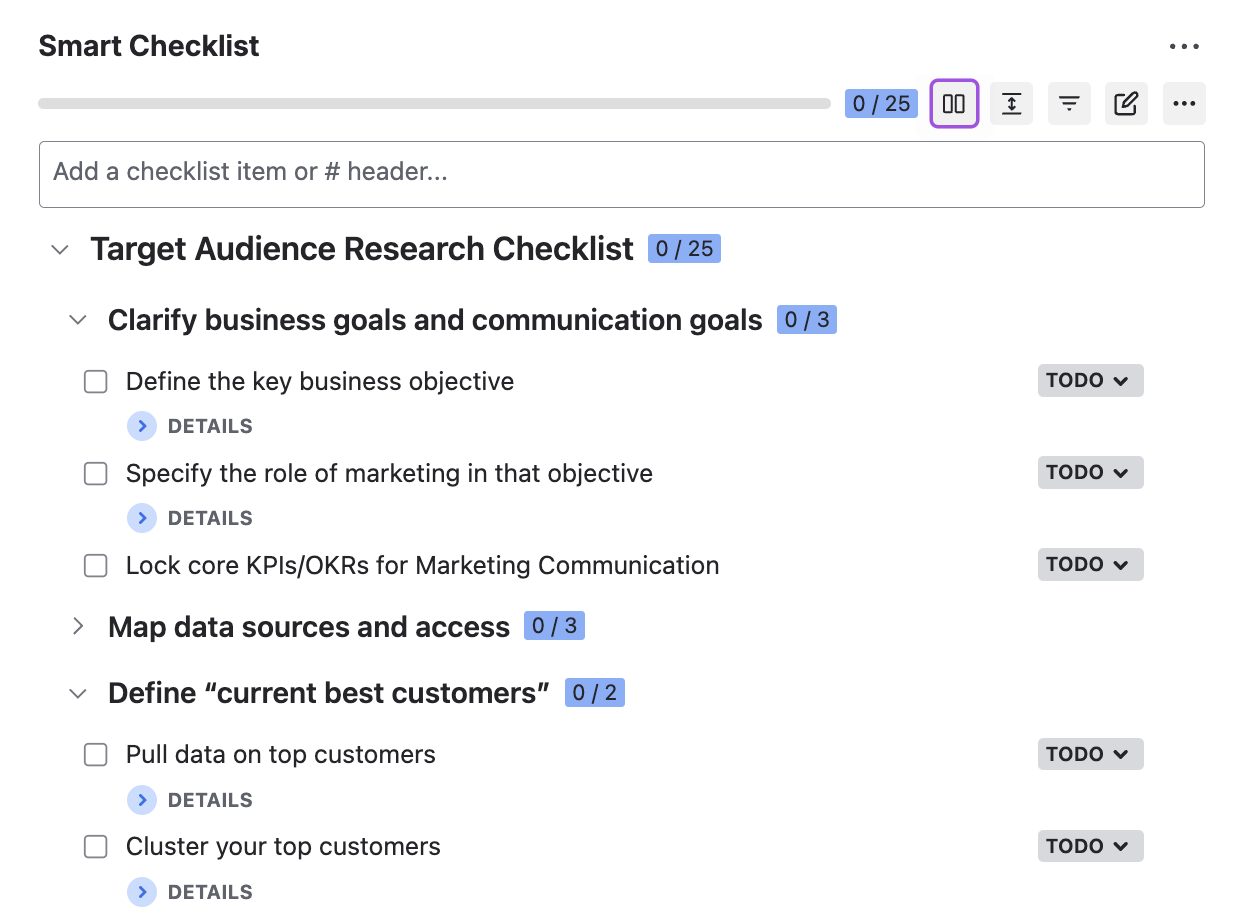
# Target Audience Research Checklist
## Clarify business goals and communication goals
- Define the key business objective
> e.g., revenue, pipeline, retention, expansion
- Specify the role of marketing in that objective
> lead gen, demand creation, product adoption, market education
- Lock core KPIs/OKRs for Marketing Communication
## Map data sources and access
- Gather already existing inventory
> CRM, product analytics, web analytics, support tickets, NPS/CSAT, sales notes, social media communication, reviews
- Identify external sources
> market reports, category benchmarks, competitor content and ads, social listening, search trends
- Verify data quality
> assure there’s no tracking gaps, attribution issues, inconsistent fields, or missing segments
## Define “current best customers”
- Pull data on top customers
> by revenue, margin, retention, product usage, or strategic fit
- Cluster your top customers
> industry/vertical, company size, geography, use case, pricing tier, channel/source
## Build / refine ICP
- Company-level: industry, size (revenue, headcount), tech stack, maturity, regulatory constraints, geo.
- Problem-level: primary jobs-to-be-done, urgency, buying trigger events, current alternatives.
- Value-level: why you’re chosen versus status quo or competitors
> e.g., speed, cost, risk reduction, experience, differentiation
- List decision-makers, budget holders, champions, influencers, blockers, and end users.
- For each: function, seniority, KPIs, what “success” looks like, what they fear.
- Map buying committee dynamics: who initiates, who vetoes, who signs, who is ignored in comms today.
## Segment the audience
### Decide on your segmentation axes:
- Firmographic (industry, size, region).
- Demographic (role, seniority, function).
- Psychographic (mindset, risk profile, innovation adoption, culture).
- Behavioral (product usage, lifecycle stage, engagement level, pricing tier).
## Channel and message-to-market fit
> For each priority segment:
- Rank channels by proven performance and qualitative fit
> e.g., outbound, search, partner, community, events, paid social
- Define the core pains for each ICP
- Define the core gains for each ICP
- Extract 3–5 messages: primary benefit, key proof point, differentiator, risk-reversal, urgency driver.
## Documentation and enablement
- Produce a one-page summary per segment: who they are, what they care about, why they buy, how to talk to them, how not to.
- Create quick-reference sheets for sales and customer support: qualifying questions, red flags, objection-handling notes.
- Store in a single, version-controlled location with clear ownership and a specified review cadence.
# Target Audience Research Checklist
## Clarify business goals and communication goals
- Define the key business objective
> e.g., revenue, pipeline, retention, expansion
- Specify the role of marketing in that objective
> lead gen, demand creation, product adoption, market education
- Lock core KPIs/OKRs for Marketing Communication
## Map data sources and access
- Gather already existing inventory
> CRM, product analytics, web analytics, support tickets, NPS/CSAT, sales notes, social media communication, reviews
- Identify external sources
> market reports, category benchmarks, competitor content and ads, social listening, search trends
- Verify data quality
> assure there’s no tracking gaps, attribution issues, inconsistent fields, or missing segments
## Define “current best customers”
- Pull data on top customers
> by revenue, margin, retention, product usage, or strategic fit
- Cluster your top customers
> industry/vertical, company size, geography, use case, pricing tier, channel/source
## Build / refine ICP
- Company-level: industry, size (revenue, headcount), tech stack, maturity, regulatory constraints, geo.
- Problem-level: primary jobs-to-be-done, urgency, buying trigger events, current alternatives.
- Value-level: why you’re chosen versus status quo or competitors
> e.g., speed, cost, risk reduction, experience, differentiation
- List decision-makers, budget holders, champions, influencers, blockers, and end users.
- For each: function, seniority, KPIs, what “success” looks like, what they fear.
- Map buying committee dynamics: who initiates, who vetoes, who signs, who is ignored in comms today.
## Segment the audience
### Decide on your segmentation axes:
- Firmographic (industry, size, region).
- Demographic (role, seniority, function).
- Psychographic (mindset, risk profile, innovation adoption, culture).
- Behavioral (product usage, lifecycle stage, engagement level, pricing tier).
## Channel and message-to-market fit
> For each priority segment:
- Rank channels by proven performance and qualitative fit
> e.g., outbound, search, partner, community, events, paid social
- Define the core pains for each ICP
- Define the core gains for each ICP
- Extract 3–5 messages: primary benefit, key proof point, differentiator, risk-reversal, urgency driver.
## Documentation and enablement
- Produce a one-page summary per segment: who they are, what they care about, why they buy, how to talk to them, how not to.
- Create quick-reference sheets for sales and customer support: qualifying questions, red flags, objection-handling notes.
- Store in a single, version-controlled location with clear ownership and a specified review cadence.
Competitor Analysis Checklist Template
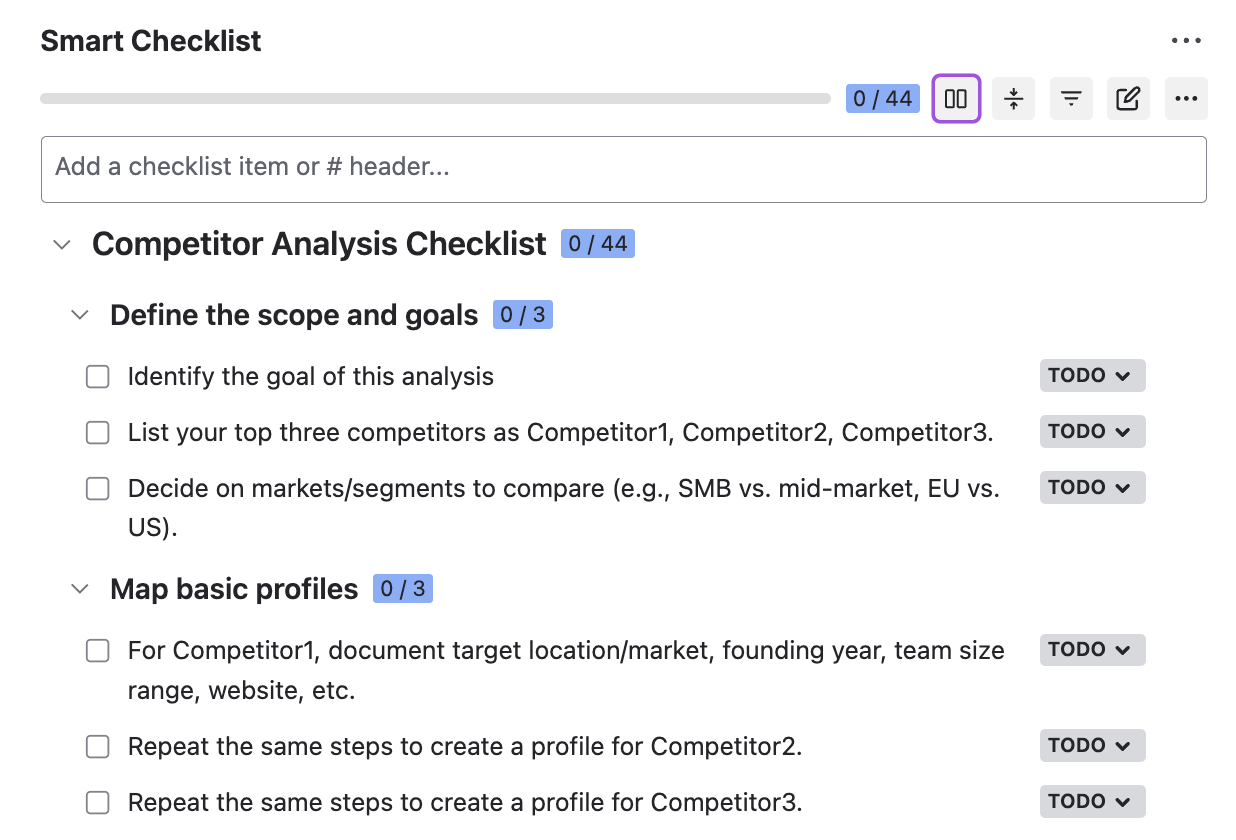
# Competitor Analysis Checklist
## Define the scope and goals
- Identify the goal of this analysis
- List your top three competitors as Competitor1, Competitor2, Competitor3.
- Decide on markets/segments to compare (e.g., SMB vs. mid-market, EU vs. US).
## Map basic profiles
- For Competitor1, document target location/market, founding year, team size range, website, etc.
- Repeat the same steps to create a profile for Competitor2.
- Repeat the same steps to create a profile for Competitor3.
## Capture the product offering and positioning
- List core products or plans for Competitor1 and note which of them map to your own, highlighting any unique offers or bundles.
- Repeat for Competitor2.
- Repeat for Competitor3.
- Write each competitor’s core value proposition in your own words from their home and product pages.
## Draw feature and capability comparison
- Create a simple table of core features and mark which of them are offered by you, Competitor1, Competitor2, Competitor3.
- Highlight 3 features where Competitor1 is clearly stronger or more mature.
- Highlight 3 features where Competitor2 is clearly stronger or more mature.
- Highlight 3 features where Competitor3 is clearly stronger or more mature.
- Mark 3–5 features or capabilities where you have a clear edge over all three.
## Pricing and packaging
- For Competitor1, capture visible pricing, tiers, and any freemium/trial offers.
- Do the same for Competitor2.
- Do the same for Competitor3.
- Calculate approximate price comparison for a standard use case (e.g., X seats or volume) across you and all three competitors.
- Highlight any clever packaging (bundles, add-ons, guarantees) that could influence perceived value.
## Go-to-market and channels
- List Competitor1’s main acquisition channels (SEO, paid, partnerships, outbound, marketplaces, etc.) based on visible evidence.
- Repeat for Competitor2.
- Repeat for Competitor3.
- Record which channels appear to be their primary bets (volume and emphasis).
## Messaging, proof, and social presence
- For each competitor, capture 3 headline/tagline examples that show their angle.
- Note 3 recurring phrases or themes per competitor (e.g., “security,” “simplicity,” “AI-powered”).
- Count and categorize social proof for each competitor (logos, case studies, testimonials, awards).
- Check blog or resource center: identify the top 3 topics or content themes per competitor.
- Define a list of keywords they target and where they take top search positions.
## Customer feedback and reputation
- Read 10–20 reviews for Competitor1 (mix of positive and negative) and list top 3 pros and top 3 cons customers mention.
- Repeat for Competitor2 and list the top 3 pros and top 3 cons.
- Repeat for Competitor3 and list the top 3 pros and top 3 cons.
- Summarize recurring complaints across all three that your product already solves.
## SWOT analysis
- Perform SWOT analysis for Competitor1.
- Repeat for Competitor2.
- Repeat for Competitor3.
- Gather a list of opportunities for your company.
## Research results and actions
- List 3–5 ways you can reposition versus Competitor1 using your current strengths.
- List 3–5 ways you can reposition versus Competitor2 using your current strengths.
- List 3–5 ways you can reposition versus Competitor3 using your current strengths.
- Identify 3 quick-win improvements (messaging, website copy, proof, or pricing clarity) you can implement within 2 weeks.
- Identify 2–3 medium-term product or feature bets influenced by this analysis.
- Decide which competitor you will monitor most closely this quarter and why.
- Schedule a recurring review (e.g., quarterly) to update this template with new findings.
# Competitor Analysis Checklist
## Define the scope and goals
- Identify the goal of this analysis
- List your top three competitors as Competitor1, Competitor2, Competitor3.
- Decide on markets/segments to compare (e.g., SMB vs. mid-market, EU vs. US).
## Map basic profiles
- For Competitor1, document target location/market, founding year, team size range, website, etc.
- Repeat the same steps to create a profile for Competitor2.
- Repeat the same steps to create a profile for Competitor3.
## Capture the product offering and positioning
- List core products or plans for Competitor1 and note which of them map to your own, highlighting any unique offers or bundles.
- Repeat for Competitor2.
- Repeat for Competitor3.
- Write each competitor’s core value proposition in your own words from their home and product pages.
## Draw feature and capability comparison
- Create a simple table of core features and mark which of them are offered by you, Competitor1, Competitor2, Competitor3.
- Highlight 3 features where Competitor1 is clearly stronger or more mature.
- Highlight 3 features where Competitor2 is clearly stronger or more mature.
- Highlight 3 features where Competitor3 is clearly stronger or more mature.
- Mark 3–5 features or capabilities where you have a clear edge over all three.
## Pricing and packaging
- For Competitor1, capture visible pricing, tiers, and any freemium/trial offers.
- Do the same for Competitor2.
- Do the same for Competitor3.
- Calculate approximate price comparison for a standard use case (e.g., X seats or volume) across you and all three competitors.
- Highlight any clever packaging (bundles, add-ons, guarantees) that could influence perceived value.
## Go-to-market and channels
- List Competitor1’s main acquisition channels (SEO, paid, partnerships, outbound, marketplaces, etc.) based on visible evidence.
- Repeat for Competitor2.
- Repeat for Competitor3.
- Record which channels appear to be their primary bets (volume and emphasis).
## Messaging, proof, and social presence
- For each competitor, capture 3 headline/tagline examples that show their angle.
- Note 3 recurring phrases or themes per competitor (e.g., “security,” “simplicity,” “AI-powered”).
- Count and categorize social proof for each competitor (logos, case studies, testimonials, awards).
- Check blog or resource center: identify the top 3 topics or content themes per competitor.
- Define a list of keywords they target and where they take top search positions.
## Customer feedback and reputation
- Read 10–20 reviews for Competitor1 (mix of positive and negative) and list top 3 pros and top 3 cons customers mention.
- Repeat for Competitor2 and list the top 3 pros and top 3 cons.
- Repeat for Competitor3 and list the top 3 pros and top 3 cons.
- Summarize recurring complaints across all three that your product already solves.
## SWOT analysis
- Perform SWOT analysis for Competitor1.
- Repeat for Competitor2.
- Repeat for Competitor3.
- Gather a list of opportunities for your company.
## Research results and actions
- List 3–5 ways you can reposition versus Competitor1 using your current strengths.
- List 3–5 ways you can reposition versus Competitor2 using your current strengths.
- List 3–5 ways you can reposition versus Competitor3 using your current strengths.
- Identify 3 quick-win improvements (messaging, website copy, proof, or pricing clarity) you can implement within 2 weeks.
- Identify 2–3 medium-term product or feature bets influenced by this analysis.
- Decide which competitor you will monitor most closely this quarter and why.
- Schedule a recurring review (e.g., quarterly) to update this template with new findings.
How to Add These Checklists to Your Jira Work Items
- Install Smart Checklist for Jira from the Atlassian Marketplace.
- Copy the target audience research checklist or competitor analysis checklist shared above.
- Paste it into the Smart Checklist section of your work item.
- Customize the checklist to fit your needs. You can tag team members, add deadlines, include links to internal resources, or add expandable sections for individual steps.
- Save the checklist as a template if your team conducts competitor analysis regularly or works with multiple clients. This way, you can reuse it across projects with just a few clicks.
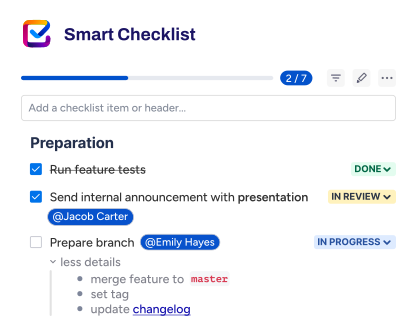
A Competitor Analysis Template Organized as a Set of Jira Work Items
If your research process is more complex or involves multiple people, a checklist inside a single work item may not be enough. In this case, you can organize your template as a set of Jira work items with child tasks.
For example, you can create a parent task called “Marketing Research: {{Project Name}}” and add subtasks for each stage of the process. This can be audience research, competitor analysis, channel evaluation, or something else. Each subtask can have its own description, checklist, assignee, and due date.
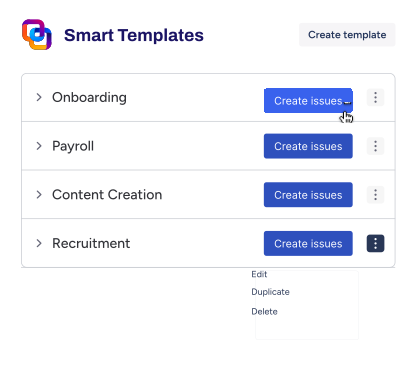
With Smart Templates, you can save this entire structure as a reusable template and share it across all projects in your Jira instance. Once saved, the entire set of work items can be generated with one click or even automatically on a schedule.
Here’s an example of a competitor analysis template organized as a set of Jira work items (Epic + Tasks + checklists):
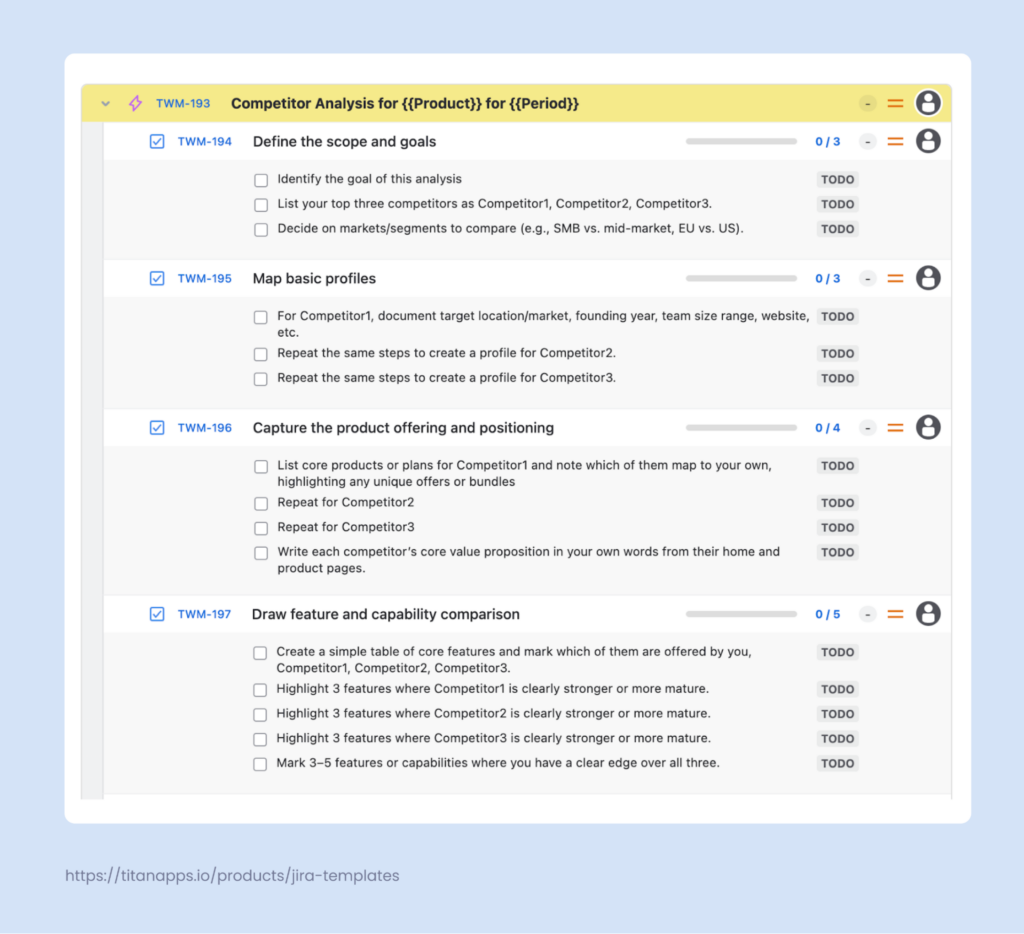
Smart Templates also support variables for dynamic parameters, such as {{Product}}, {{Country Name}}, or {{Client Name}}. You add them to your template as placeholders, and they get replaced with actual values each time you generate new tasks from the template.
This approach is especially valuable for teams that conduct marketing research frequently, whether for different clients, campaigns, or products. Instead of setting up tasks manually each time, you get a ready-made structure with all the steps, owners, and details already in place.
Benefits of Using Smart Tools for Your Marketing Research Templates
Using Smart Checklist and Smart Templates together provides your marketing team with a practical system for managing research. Here’s what this setup brings to the table:
- Standardized process. Every research or competitor analysis project follows the same structure, no matter who runs it or how often it’s done.
- Clear ownership. Team members are assigned to specific steps or subtasks, ensuring everyone knows their responsibilities.
- Progress at a glance. You can check the status of any research project by looking at the checklist or task board – no need to chase people for updates.
- Less manual setup. Saved templates eliminate repetitive work. Instead of creating the same tasks from scratch, you generate them in a few clicks.
- Automation support. Checklists can be assigned to work items automatically based on conditions, and work item templates can be generated on a schedule.
- Easier onboarding. New team members can follow the established research process without needing a detailed walkthrough.
Best Practices for Marketing Research and Competitor Analysis
Here are some practical tips that help us keep our marketing research process efficient and useful:
- Start with a research goal, not with data collection. Before diving into tools and spreadsheets, take the time to define what you’re looking for and how it aligns with your business and marketing goals. A clear research goal and plan keep the team focused and prevent you from collecting data you’ll never use.
- Don’t overload your market research report with raw data. Stakeholders care about insights, not spreadsheets. Focus your market research findings on what matters most: key patterns, clear takeaways, and specific recommendations that can inform business strategies.
- Mix quantitative and qualitative methods. Numbers show you what’s happening, but conversations explain why. Combine metrics from your analytics tools with customer interviews or surveys to get a fuller picture.
- Set a timebox and stick to it. Research can expand endlessly if you let it. Give your team a clear deadline and prioritize the highest-impact areas first. A good-enough market analysis delivered on time is more valuable than a perfect one delivered too late.
- Be ready for changes. With every research or competitor analysis project, you can discover many ways to optimize your messaging, channels, or strategy. Be prepared to invest time into implementation and testing different options – this will make your research truly impactful.
- Conduct research regularly. Even major marketing research becomes outdated over time: the market is changing, new competitors are emerging, and the audience is evolving. Ensure you regularly update your knowledge to keep your strategy relevant.
Additional Tips For Competitor Analysis
- Focus on a small set of competitors. Trying to track every player in the market is overwhelming. Pick 3–5 direct competitors and 2–3 indirect ones. You can always expand later.
- Don’t just copy what competitors do. The goal of competitor analysis is to find opportunities, not to replicate someone else’s strategy. What works for them may not work for your audience or business model.
- Track competitors over time, not just once. A single snapshot is useful, but ongoing monitoring helps you spot shifts in strategy, new campaigns, or changes in positioning before they affect your market share.
- Use a consistent format for competitor audits. A simple matrix or spreadsheet makes it easier to compare competitors side by side and update findings over time.
Organize Work Efficiently With Your Marketing Research Template
A well-structured marketing research template helps your team streamline the process from start to finish. Whether you’re analyzing customer experiences to improve retention, exploring demographic and psychographic data to better understand your ideal customer, or conducting market research to inform product development, having a repeatable system makes a real difference.
The templates shared in this article provide a practical starting point. Use the checklist format for lightweight research projects or set up a full work item structure for more complex initiatives. Both options work natively in Jira with Smart Checklist and Smart Templates by TitanApps.
For more templates and guides, please refer to our other articles:
- Market Research Template for Jira – a guide for building a template that focuses on target market analysis, market share evaluation, and risk assessment.
- SEO Audit Template – walks you through a structured methodology for auditing your website’s search performance.
- Product Discovery Template – offers a step-by-step checklist for validating product ideas.
- Marketing Management Guide – provides a broader look at how to organize and manage your marketing team’s workflow in Jira.
FAQs: Using Templates in Marketing Research and Competitor Analysis
What is marketing research?
Marketing research is the process of gathering and analyzing information to support marketing decisions. It can cover a wide range of activities, from studying your target audience and evaluating competitors to reviewing channel performance and tracking industry trends. The goal is to replace assumptions with evidence so your team can plan and execute more effectively.
How is marketing research different from market research?
Market research focuses on understanding the market itself. This includes aspects like market size, demand, customer segments, and pricing.
Marketing research is broader. It encompasses any research that informs marketing activities, including channel evaluation, content analysis, brand perception, and campaign performance.
What does a marketing research process typically look like?
It usually begins with defining the research objective and the decision it should inform. From there, the team determines what data is needed and where to obtain it. This is followed by data collection, which can include analytics review, competitor audits, surveys, or interviews. Once the data is gathered, it’s analyzed and summarized into key findings. The final step is to present recommendations and assign next steps.
What is competitor analysis?
Competitor analysis is the process of studying what other companies in your space are doing in terms of marketing. This includes their positioning, messaging, content, pricing, advertising, and channel strategy. The goal is to understand their strengths and weaknesses so you can find opportunities to differentiate and make more informed marketing decisions.
What should a competitor analysis include?
The scope depends on your goals, but a typical competitor analysis covers several core areas:
- Identifying direct and indirect competitors
- Reviewing their websites, messaging, and value propositions
- Analyzing their content strategy
- Checking their social media presence
- Reviewing their paid advertising
- Documenting findings
Why should teams use a marketing research template?
Such a template gives your research process a clear structure. Without one, it’s easy to skip important steps, lose track of findings, or approach each project differently depending on who’s running it. With a template, the team follows the same process every time. This saves time, improves consistency, and makes onboarding new team members easier.
Who is responsible for marketing research in a team?
It depends on the team’s size and structure. In smaller teams, research is often handled by a marketing generalist or the team lead. In larger organizations, it may involve multiple people, such as a content marketer handling competitive content analysis while a PPC specialist reviews ad performance.
What methods can marketing teams use to collect research data?
There are many ways to gather data for marketing research. The right mix depends on your goals, timeline, and available resources. Here are some key methodologies:
- Surveys and questionnaires. Collect structured feedback from customers or prospects using tools like Google Forms, Typeform, or SurveyMonkey.
- Customer interviews. Have one-on-one conversations to gain deeper context on motivations, pain points, and decision-making.
- Social listening. Monitor brand mentions, industry discussions, and audience sentiment across social media platforms.
- Competitor analysis. Review competitor websites, ads, content, and public communications to identify patterns and positioning.
- Focus groups. Bring together a small group of target users to discuss perceptions, preferences, or reactions to specific ideas.
- Third-party reports and industry data. Use research from firms like Gartner, Statista, or HubSpot to benchmark against broader market trends.