





 Tools for Jira
 Tools for monday.com





Team: QA & Engineering
Industry: SaaS
Employees: up to 1000
Problem
Kateryna Ivanchenko was a QA Engineer on a 10-person team. The team was running on two separate tools: Jira for issue tracking and TestRail for test plans. On paper, the split made sense, but it had structural limits that were becoming difficult to ignore:
- TestRail was shared across multiple teams. That meant their test plan couldn’t be changed without affecting others, meaning adapting the process to fit how this team actually worked wasn’t really an option.
- Not everyone had TestRail access, while Jira was available to the whole team. That gap alone created daily friction.
Over time, the gaps added up:
- Fragmented workflow: QAs had to move between two tools to understand what needed testing and how – with no clean way to connect the two.
- Inconsistency: Without a standardized process inside Jira, different QAs approached the same test cases differently.
- Compliance and traceability: Important steps were occasionally skipped – not out of negligence, but because the process simply wasn’t visible where the work was being done.
We had TestRail for test plans and Jira for tracking. The bigger issue wasn’t the switching – it was that the test plan belonged to multiple teams. We couldn’t adapt it to fit how we worked, and not everyone even had access to TestRail.

Solution
The move to Smart Checklist didn’t happen in one step. First, the team migrated their test plan from TestRail into Confluence – specifically, a Database Page. That step was deliberate: it gave them a safe space to review the existing process, clean it up, fill in gaps, and shape it around how their team actually worked – without touching the shared TestRail plan that other teams depended on.
Only after that, they brought the process into Jira using Smart Checklist functionality.
We moved to Confluence first – it gave us ownership of the process without disrupting other teams. Then Smart Checklist made it actionable, right where the work was already happening.
She built out checklist templates for their most common test cases – structured, reusable, and detailed enough that every QA on the team knew exactly what was expected at each step. No more cross-referencing and guesswork.
On a higher level, every checklist was divided into categories with headers for better organization and structure. Additionally, every checklist item had a filled-in “Details” that held the real substance: how to perform the step, what exactly to check, what to look for.
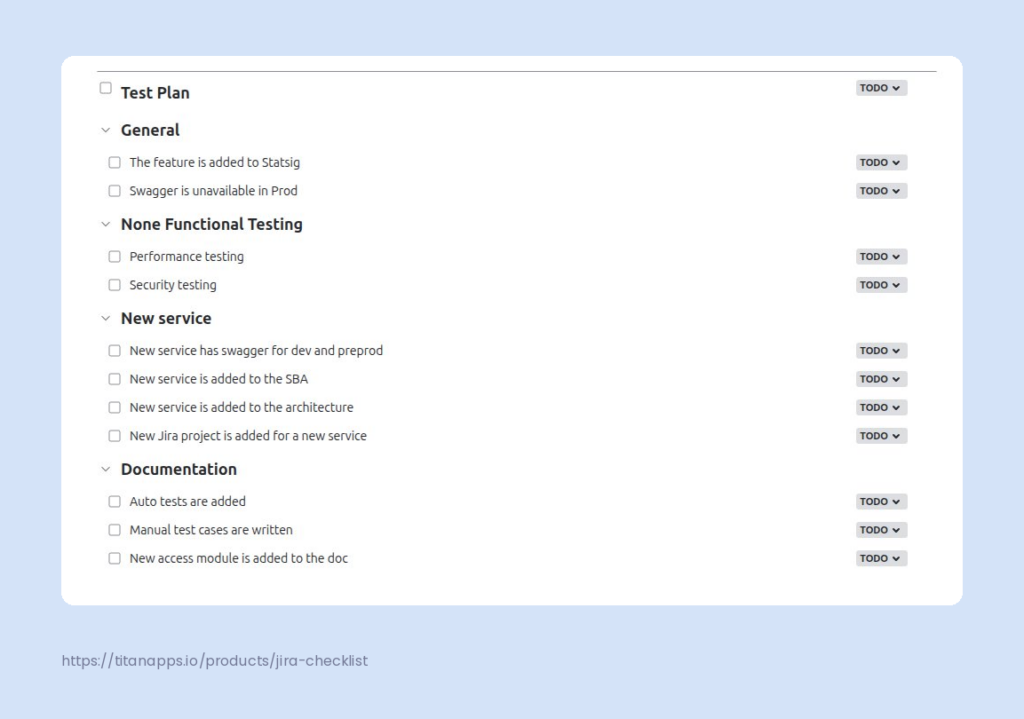
This turned a simple To-Do list into a solid test case alternative.
To make the checklists reflect how QA work actually operates, the team added custom statuses. Steps that didn’t apply to a specific case could be marked as Skipped rather than left open or awkwardly ticked off. They also added a Blocked status for any step that can’t be completed yet but shouldn’t be forgotten – a clear signal that the work is pending, not abandoned.
One of the more practical wins was how Smart Checklist scaled across different levels of the issue hierarchy. A high-level checklist could be attached to an epic to track the overall feature release – covering the big picture steps before anything ships. Then, individual tasks and stories inside that epic could carry their own detailed checklists with specific testing instructions. Same tool, two levels of granularity, all visible inside Jira.
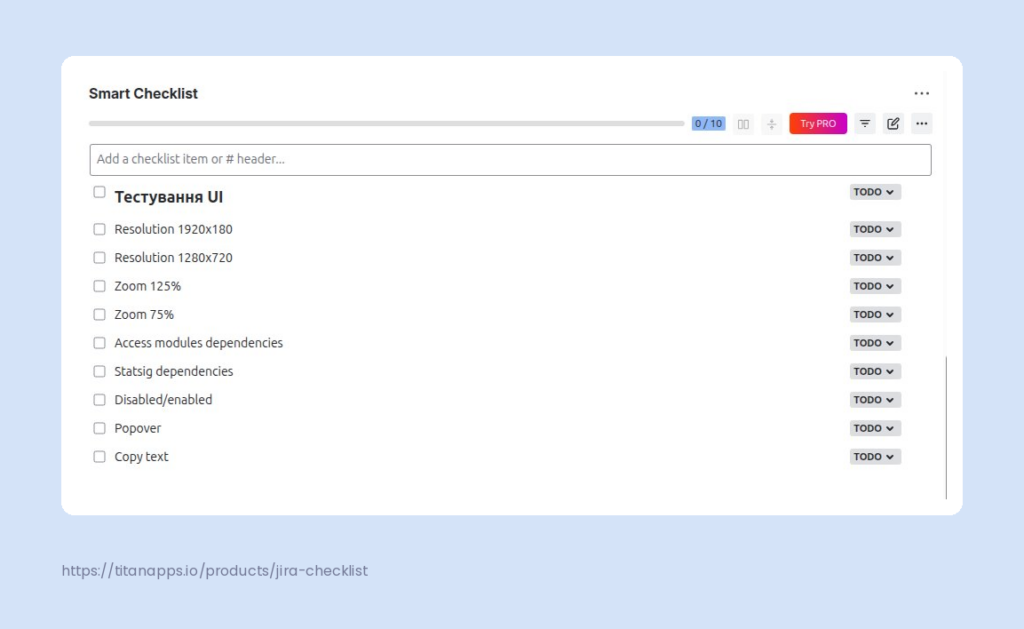
After the checklist implementation, TestRail didn’t hold the whole process anymore – most of it lived where the work happened.
Results
- Single source of truth: Manual testing processes moved fully into Jira – no more switching between tools to find what needs to be done
- Team-oriented workflow: Ability to create a custom workflow by team without affecting others
- Standardized test cases: Reusable checklist templates ensure every QA follows the same process, every time
- Custom statuses: Workflow states like Skipped and Blocked reflect how QA work actually progresses turning generic checklist model into process management tool
- Transparency by default: Important steps can’t be quietly bypassed – they’re visible, tracked, and part of the workflow
- Progress visibility: Managers and team members see exactly where each test case stands, without chasing updates
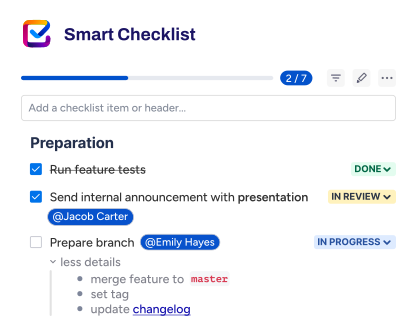
For Kateryna’s team, the shift was never to abandon TestRail – it still handles automated testing just fine. The goal was more focused: take ownership of the manual testing process, adapt it to how their team actually works, and bring it into Jira – where everyone already was. With Smart Checklist, the process, the context, and the work all live in one place.