






 Tools for Jira
 Tools for monday.com





A process audit in Jira is the practice of proving that every required step of a recurring workflow was completed, for every request, issue, or incident. Use it when your team runs repeatable processes (security checks, access reviews, payroll tasks, incident response) and you need consistent evidence across many Jira issues. Audits fail when steps live in people’s heads, checklists drift between teams, or there is no reliable way to show what was actually done.
The fastest way to make Jira audit-ready is to standardize the steps inside your work items (issues) and keep those steps controlled over time. A one-off checklist in a single issue does not scale. Processes change. Teams copy old versions. Requirements drift. After a few months, it becomes hard to prove that everyone followed the same standard.
Smart Checklist for Jira solves this with Linked Templates. Linked Templates turn a recurring process into a reusable checklist that stays consistent across issues and projects. When the template changes, updates can stay connected, so the process remains centralized instead of splitting into multiple versions.
Use Linked Templates when you need:
- one source of truth for a recurring process in Jira
- consistent execution across team members and projects
- a clear audit trail that shows required steps were followed
- fewer gaps caused by manual copy-paste or “personal” checklist versions
This approach fits finance teams (payroll and access reviews), security and IT teams (vendor checks, infrastructure controls), and support or operations teams (incident response and service requests). Jira already tracks the work. Linked Templates make the process inside each work item consistent enough to audit.
How to keep recurring Jira processes consistent for audits
A checklist is one of the simplest ways to keep work consistent. It reduces missed steps because the process is visible and repeatable.
Recurring processes in Jira are rarely that simple. Many workflows require multiple Jira issue types, different templates, and supporting checklists across subtasks or linked work items.
Process drift is the real risk. Teams adjust descriptions, rename steps, or copy an older version of a checklist. After a few months, you end up with several “almost the same” versions of the process across projects and team members.
This becomes a real problem when the process must stay strict:
- A regulator requires the same steps every time
- Your internal policy demands an auditable trail
- The process changes and you must update it centrally
- You need to prove compliance during an audit of your Jira instance
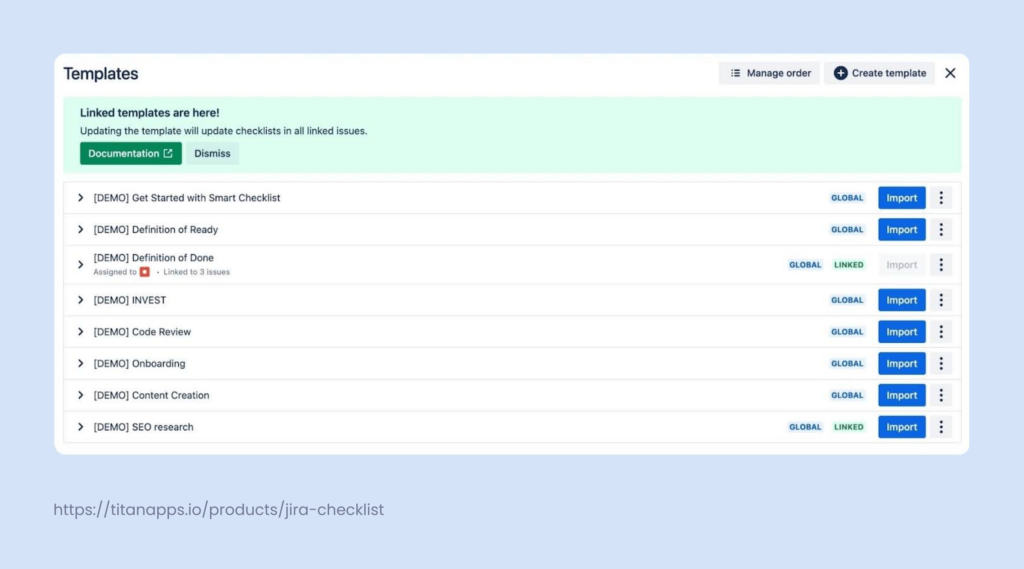
This is exactly what Linked Templates in Smart Checklist for Jira are built for. They keep a recurring checklist connected to a single source of truth, so the process stays consistent across issues and projects.uth, so the process stays consistent across issues and projects.
What are Linked Templates in Smart Checklist for Jira.Pro?
Linked Templates are an advanced type of Smart Checklist template designed for processes that must stay consistent across many Jira issues.
Unlike regular templates, which add a one-time snapshot of a checklist into an issue, Linked Templates stay connected to every issue where they are used. This live connection is what makes them useful for audits and compliance work.
What makes Linked Templates different from any other checklist template?
- Live connection – when you import a Linked Template into a Jira issue, the issue keeps a live link to the original template. You can later see where this template is used and manage all linked issues from the template manager.
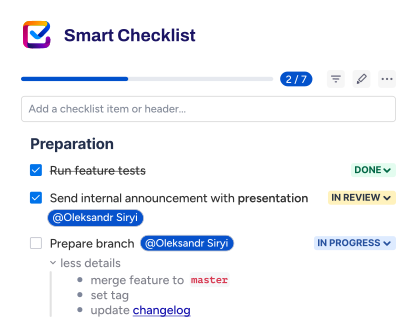
- Immutability for regular users – team members working on issues cannot change the content of the linked checklist. They can only update item statuses (for example, mark a step as done or skipped). This means the process itself stays “frozen”, while progress can still move forward.
- Central updates, synced everywhere – when an admin or process owner edits the original Linked Template, those changes are automatically reflected in every Jira issue where this template is imported.You update the process once, and all current and future issues stay aligned.
This combination of control and reusability makes Linked Templates a strong foundation for any process that must be executed the same way every time and later reviewed as part of an audit or certification.
What are the key benefits of using Linked Templates in Jira?
The main appeal of a Linked Template is its immutability. An important process that you’ve set up once will remain unchanged. At the same time, the team will still have detailed steps and ToDos for their issues.
That said, change is a natural occurrence in every growing business. Your processes are continuously being polished and perfected. However, making changes in every issue that has a template applied to it one by one is rather troublesome and extremely time-consuming.
This is why the Linked Templates feature allows you to apply the changes you’ve made in a template to every issue where it is used.
What Does It Mean to Audit Your Processes in Jira?
When we talk about a “Jira audit” in this article, we don’t mean a technical audit of Jira itself, its plugins, or system logs. That kind of work belongs to Jira admins and Atlassian documentation.
Here, the focus is different: we talk about auditing the business processes that your teams run in Jira.
For many companies, Jira has already become the place where financial checks, security controls, and operational routines live. Finance might track monthly reconciliations and payroll checks as Jira issues. Security and compliance teams might manage access reviews, vendor assessments, or incident follow-ups there. Ops and support teams often rely on Jira to structure customer ticket flows or internal service requests.
In all these cases, Jira is more than just a ticketing tool. Each recurring process is represented as a series of issues, the detailed steps live in checklists or templates, and the history of work is visible over time.
An audit of processes in Jira means going through those issues and verifying that the same approved steps were followed every time. For example, an auditor can review all “Monthly log review” issues for the last year and check that each one contains the same standardized checklist, completed by the right people. The goal is to show that the process was consistent and that required steps were not quietly removed or changed in individual issues.
Linked Templates make this practical. They help you prove that the process definition stayed the same across months or projects, and that teams only updated the status of checklist items rather than rewriting the process itself.
What Processes Can You Audit Using Linked Templates?
Linked Templates work best for recurring, regulated, and cross-team processes. Anywhere you need the same sequence of steps to be followed every time, they can become the backbone of your Jira-based audit trail.
In practice, that often means compliance and certification work. The same control must be performed every month or every quarter. The same checks must be run across products, regions, or environments. Jira issues represent these activities, and Linked Templates turn them into repeatable, reviewable workflows.
Some typical examples:
- SOC 2 controls – internal teams need to confirm that security, availability, and access controls are applied consistently. A Linked Template can describe the steps of a monthly log review, an access review, or a backup verification process. Each time a new Jira issue is created for that activity, the same checklist appears, and the auditor can compare issues across the year. Our Template for Compliance Audit in Jira shows how such a checklist can look in practice and how it can be reused across audits.
- GDPR and privacy workflows – privacy teams often rely on Jira to manage data deletion or data subject requests. A Linked Template can hold every step required to handle a GDPR data deletion request: identify systems, confirm the requester, remove data from each system, document the outcome. Our GDPR Data Deletion Request Template for Jira article explains this flow and can be combined with Linked Templates to make the process immutable across all requests.
- ISO certifications (e.g. ISO 27001) – ISO frameworks include internal audits, risk reviews, and corrective actions. A Linked Template can structure how your team performs an internal audit in Jira: define scope, gather evidence, review risks, log findings, and assign remediation tasks.
The same approach applies to HIPAA, internal security standards, vendor assessments, and other industry-specific frameworks. The key idea is simple: if a recurring process is important enough to be audited, it is important enough to be captured in a Linked Template and reused in every relevant Jira issue.
How Linked Templates Support Audit-Ready Processes
For an auditor, two things matter most: how the process is defined and whether the team followed it. Linked Templates help on both sides.
First, they give you a single, controlled definition of the process. The checklist lives in one place in Smart Checklist, and only admins or process owners can change its content. When this Linked Template is imported into Jira issues, the process comes with it intact. Teams can check items off, but they can’t rewrite the steps on their own. That solves a common audit problem: different teams quietly editing their version of the checklist.
Second, Linked Templates keep every instance of that process aligned over time. When your SOC 2 control or GDPR flow evolves, you don’t need to find and fix dozens of issues across multiple projects. You update the Linked Template once, and the new version appears everywhere it is linked. For long-running certifications or yearly ISO cycles, this avoids fragmentation and makes it easier to explain what changed and when.
Linked Templates also work well with Jira automation. You can use Automation for Jira to import a Linked Template into an issue whenever a specific condition is met: for example, when a quarterly “Access Review” task is created, or when a new GDPR deletion request is logged in a dedicated project. This reduces manual work, but more importantly, it guarantees that every relevant issue carries the correct, up-to-date checklist.
The result is a predictable pattern: for each recurring control or compliance activity, you have a series of Jira issues, each with the same linked checklist and visible progress. That structure makes it much easier to sit down with an auditor, open a set of issues, and walk through what was done, when, and according to which process definition.
Practical Use Cases for Auditing Processes in Jira
Linked Templates work best when the same process repeats many times and must stay reliable, traceable, and easy to explain. Here are a few scenarios where they shine.
1. Compliance and Certifications (SOC 2, ISO, GDPR)
For SOC 2 and ISO 27001, teams often run recurring controls: monthly log reviews, quarterly access reviews, patch management reviews, vendor risk assessments, internal audits. Each of these activities can be represented as a Jira issue, with a Linked Template attached that describes the exact steps to follow.
For example:
- A SOC 2 control can use a Linked Template similar to the one described in our Template for Compliance Audit in Jira: define scope, review controls, gather evidence, record non-conformities, assign corrective actions.
- A GDPR data deletion flow can rely on the checklist from our GDPR Data Deletion Request Template for Jira: validate the request, identify systems, delete or anonymize data in each system, confirm completion, and update the requester.
In all cases, auditors can later open those issues and see the same process applied repeatedly, instead of slightly different checklists scattered across projects.
2. Onboarding and Offboarding
HR, IT, and security teams often treat onboarding and offboarding as part of their compliance and risk management program. A Linked Template turns these flows into standard, auditable journeys.
For onboarding, a template might include account creation steps, access provisioning, training tasks, policy acknowledgments, and hardware allocation. For the offboarding process, the checklist may cover account revocation, device return, knowledge transfer, and access removal for all key systems.
Because the template is linked and immutable, each new or leaving employee goes through the same defined steps. During an internal audit or security review, you can pull up the related Jira issues and show exactly which actions were taken for each person.
3. Cross-Team Dependencies and Evolving Processes
Some processes span multiple teams or departments. For example, releasing a feature that touches finance, operations, and security, or introducing a new vendor that affects several systems. A Linked Template can list all affected teams, required approvals, and dependency checks.
When a new dependency appears (say, a new system or team that must be involved), you update the Linked Template once. That change flows into all issues where it is linked, without requiring manual edits in each issue. The process stays synchronized across teams, which is particularly useful when you later need to show who was involved and what checks were performed at different points in time.
How to Set Up Audit-Ready Processes in Jira Using Linked Templates
The basic setup is simple: first, you document your recurring process as a Linked Template in Smart Checklist (for example, a monthly SOC 2 control, an ISO internal audit, or a GDPR data deletion workflow). Then, you decide where this template should appear: specific Jira projects, issue types, or scheduled tasks created via Automation for Jira. Once the template is linked, every new issue of that type will carry the same, immutable checklist your team can execute and later show during an audit.
You can create a new template from the Templates list on the Jira Issue view or Project Settings or convert the existing template into a Linked Template. For detailed, step-by-step instructions, see the Linked Templates documentation.
Final thoughts on audit with Linked Templates
If your teams already use Jira to run finance, security, or operational workflows, Linked Templates give you a simple way to turn those recurring tasks into audit-ready processes. You define the checklist once, control updates centrally, and reuse it across all relevant Jira issues. Over time this creates a clear, consistent trail for SOC 2, ISO, GDPR, and other certifications, without adding another tool to your stack.
Would you like to know more about how Smart Checklist can help improve your processes? Then try it for free today.
FAQ: Jira Process Audits, Linked Templates, and Related Topics
How is a Jira process audit different from the Jira audit log?
A process audit in Jira focuses on issues, workflows, and templates your teams use for recurring work, such as SOC 2 controls or GDPR requests. You review how people use Jira, which checklists they follow, and which steps they complete in Smart Checklist. The Jira audit log (and related audit log pages in Atlassian docs) is an admin feature that tracks configuration changes in a Jira instance, such as updated permissions, workflow edits, or plugin installation. That area sits more in jira administration and is usually handled by a Jira admin, not by process owners.
Do Linked Templates work in both Jira Cloud and Data Center?
Smart Checklist supports Jira Cloud and Data Center, so you can build Linked Templates in both environments and keep your processes consistent across projects and issue types. The setup is similar: you manage templates from the Jira issue view or Project Settings, then apply them to relevant issue types. In larger jira instances on Data Center, teams often combine templates with other DevOps tooling (for example CI/CD jobs that call the Jira API or push data in JSON format) to keep infrastructure work and compliance tasks aligned.
What permissions are needed to manage Linked Templates?
Regular users can work with checklists inside a Jira issue, change item statuses, and complete their tasks. Managing Linked Templates themselves typically requires higher-level permissions such as specific project roles, and sometimes global permissions controlled in user management. In many teams, only people involved in jira administration or process ownership can create or edit Linked Templates, so a new user does not accidentally change a compliance flow. Access follows your usual authentication setup, whether you use Atlassian accounts, Microsoft SSO, or another identity provider.
Can I export or share audit evidence from Jira?
For many audits, it is enough to walk through the relevant Jira issues, open Smart Checklist, and show completed items directly in the UI. If you need a file, you can export issues to CSV, build an analytics or metrics dashboard, or document the process in Confluence using links to Jira. Some teams keep a separate reporting page where they summarize metrics such as number of completed checklists per period or control failures, which helps during broader reviews of process retention and performance.
Do Linked Templates work with Jira automation and integrations (Slack, GitHub, etc.)?
Yes. Linked Templates support automation scenarios, including rules built in Automation for Jira on both Jira Cloud and Data Center. You can trigger a rule when an issue is created or transitioned, then import a specific template by its ID; this fits well into DevOps and configuration changes workflows. Teams often combine rules with Slack or email notifications so that assignees know when a new audit task appears, and connect Jira to GitHub, GitLab, Bitbucket, AWS, or logging tools like Splunk through webhooks, the REST API, or other plugins to keep technical work and compliance checklists in sync.
Can Linked Templates help with troubleshooting or tracking user activity?
They do not replace the Jira audit log or detailed user activity reports. However, Linked Templates help you see where a process broke down in day-to-day work. If an incident repeat occurs, you can open the related issues, check which checklist items were missed, and use that information in your troubleshooting and improvement steps. Over time, this gives you process-level metrics that complement system-level logs and make it easier to refine how teams use Jira.
Where can I learn more about using Linked Templates in my workflows?
You can start with the Linked Templates page in the Smart Checklist documentation, which acts as a practical tutorial for setup and everyday use. From there, explore our templates for SOC 2 and ISO compliance audits, GDPR data deletion, and other regulated workflows that live in Jira and Atlassian tools. Many teams also create internal guides in Confluence that explain how to use Jira, Smart Checklist, and other collaboration tools in a single, step-by-step flow.