





 Tools for Jira
 Tools for monday.com




Team: QA & Engineering
Company: NDA
Industry: Digital / Logistics Tech
Employees: up to 1000
Problem
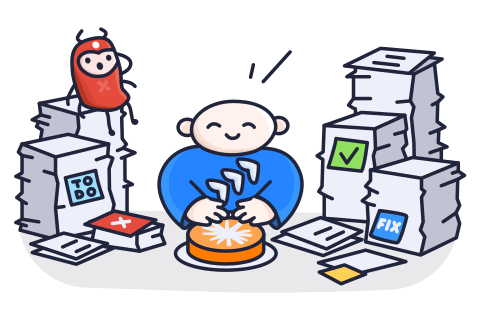
The company’s QA team was growing – and so was the friction around getting new engineers up to speed. Onboarding was technically working, but it wasn’t documented anywhere in the actionable way.
Over time, gaps started adding up:
- No single source of truth: A lack of a documented onboarding process caused inconsistencies across new hires.
- Scattered documentation: The process lived across a patchwork of documents across different sources
- Manual support: Every time a new team member joined, someone had to manually recreate the same tasks from scratch
- Lack of transparency and visibility: The process wasn’t documented in one place, limiting transparency and the ability to make retrospective improvements.
- Compliance risks: With tasks spread across multiple documents, there was no guarantee the full process was completed
Solution
The shift started at an Atlassian Community event. Kateryna Ivanchenko, Senior QA Engineer on the team, came across Smart Checklist – specifically its free version – and saw an immediate fit.
The free version offered the right entry point: a low barrier to entry, immediate value, and no commitment or purchasing approval required before the team could verify if it solved their problem. She initiated the app installation within their existing Jira instance and got to work rebuilding the onboarding process from the ground up, directly inside Jira.
She took the existing workflow and translated it into a Smart Checklist: one structured, detail-rich list of tasks that covered every step of the onboarding journey. Each item wasn’t just a checkbox – she added context, useful links and just simple practical advice directly to the details section under each checklist item. Now neither the onboardee nor the manager needed to fall into document searching and double-checking tasks.
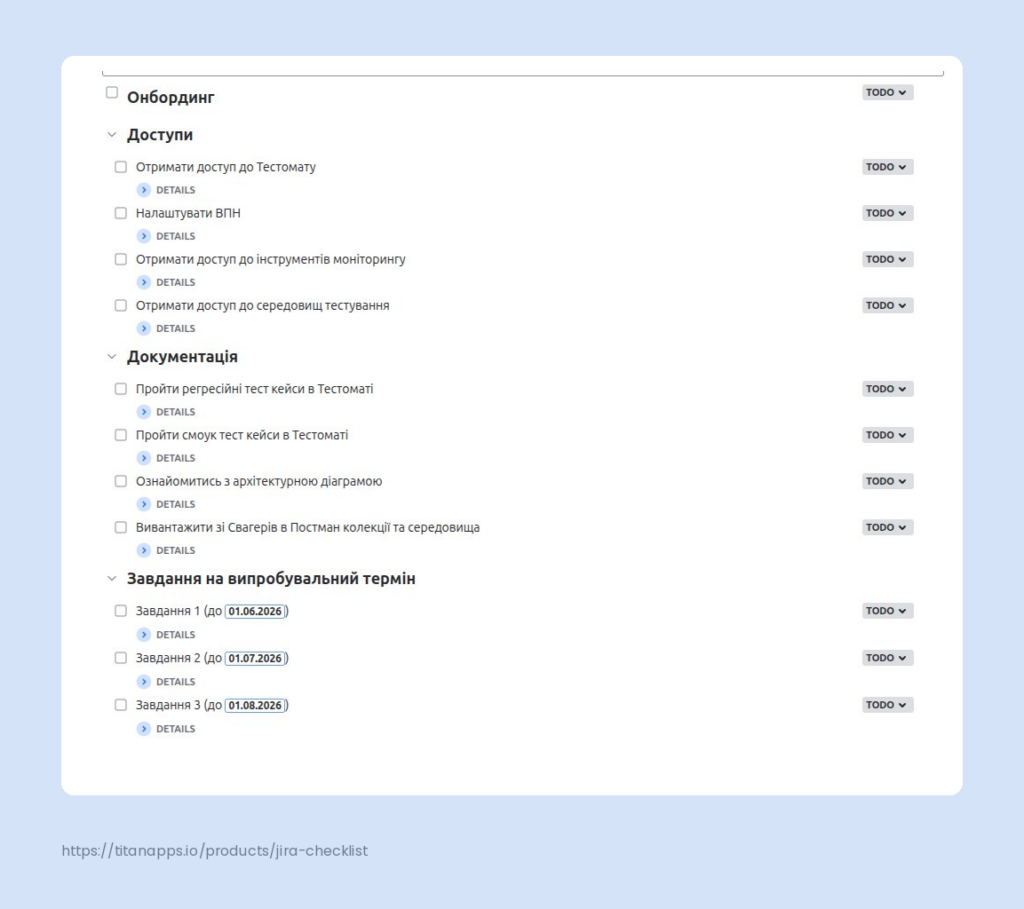
Our onboarding process existed, but it was scattered everywhere. Every time someone new joined, I was basically rebuilding it from memory. That’s not a solid process

Once the checklist was refined and tested in, she saved it as a template. Now, every time someone new joins the team, the same structured, pre-filled checklist is ready to go – no manual recreation, no missing steps.
The onboarding process went from scattered to standardized. Both managers and new hires now have a shared, real-time view of progress – who’s done what, what’s still open, and what comes next. Documenting the process brought one additional, less obvious benefit: centralization allows the team to easily apply improvements and shorten the communication loop. If a call with a Team Lead is no longer required during the first week, they can just remove the checklist item and the process is already up to date.
Now when someone joins the team, the checklist is just there. The manager knows what’s pending, the new hire knows what’s expected, and I don’t have to chase anyone for updates. That’s the difference.
Results
- Standardized onboarding: one template, applied consistently across every new team member – no manual recreation
- Full process visibility: managers and onboardees track progress in real time, directly inside Jira
- Compliance by default: every required step is documented, assigned, and trackable
- Richer task context: links, instructions, and notes live inside each checklist item – no more “document hunting.”
- Free tier adoption: Smart Checklist’s free version gave the team a risk-free way to validate the tool before diving into purchasing workflow and scaling
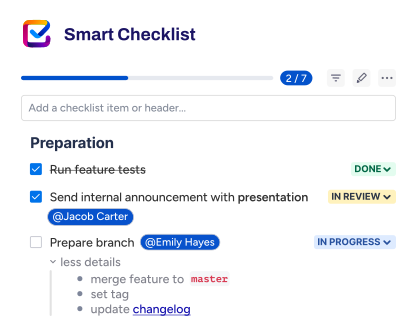
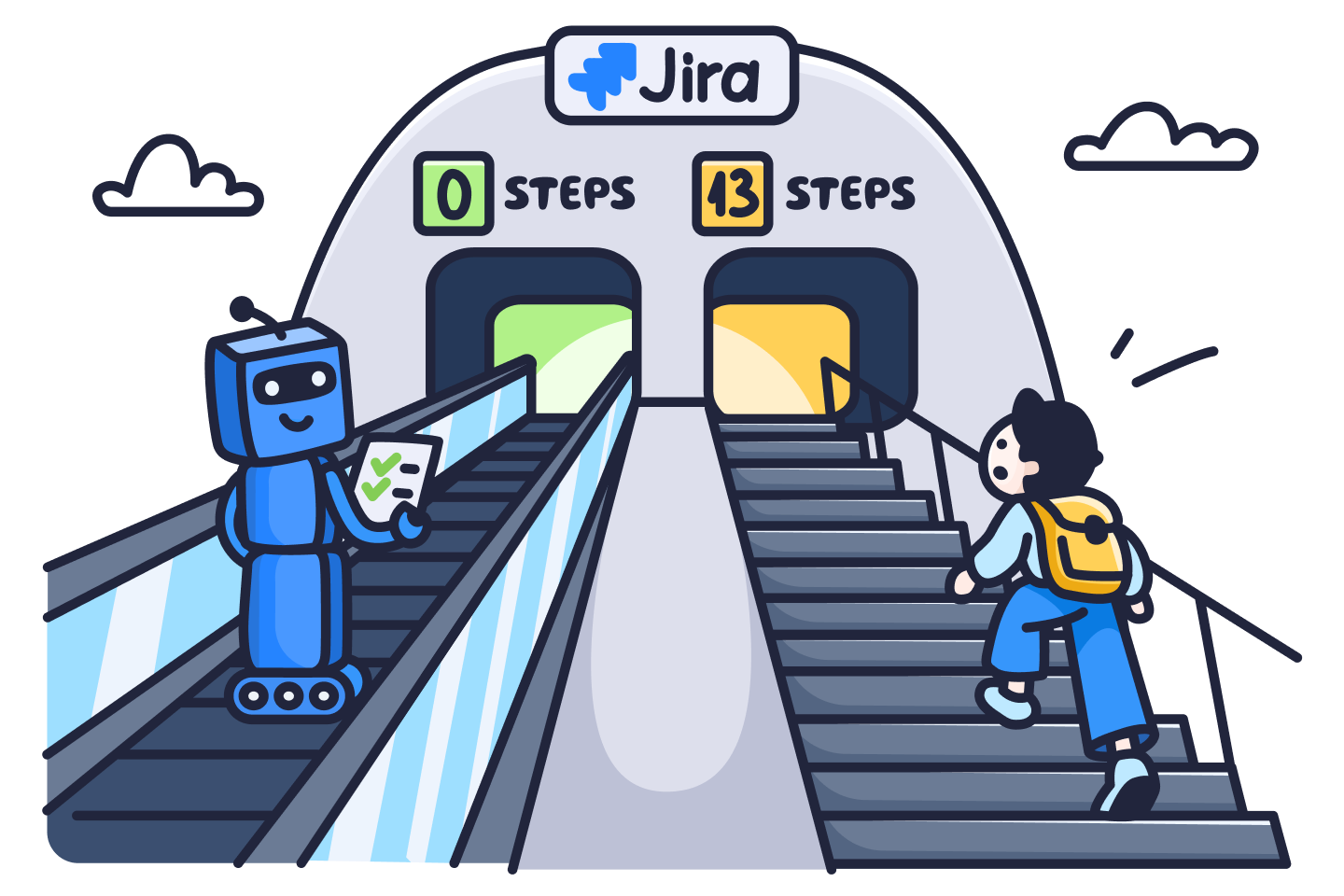
For the QA team, the transformation wasn’t about adding a new tool – it was about making an existing process finally work. With Smart Checklist, onboarding went from something that happened around Jira to something that happens in Jira: structured, visible, and repeatable from day one.